The residency
One does not come to Dar al-Hiraf for a course. One lives there.
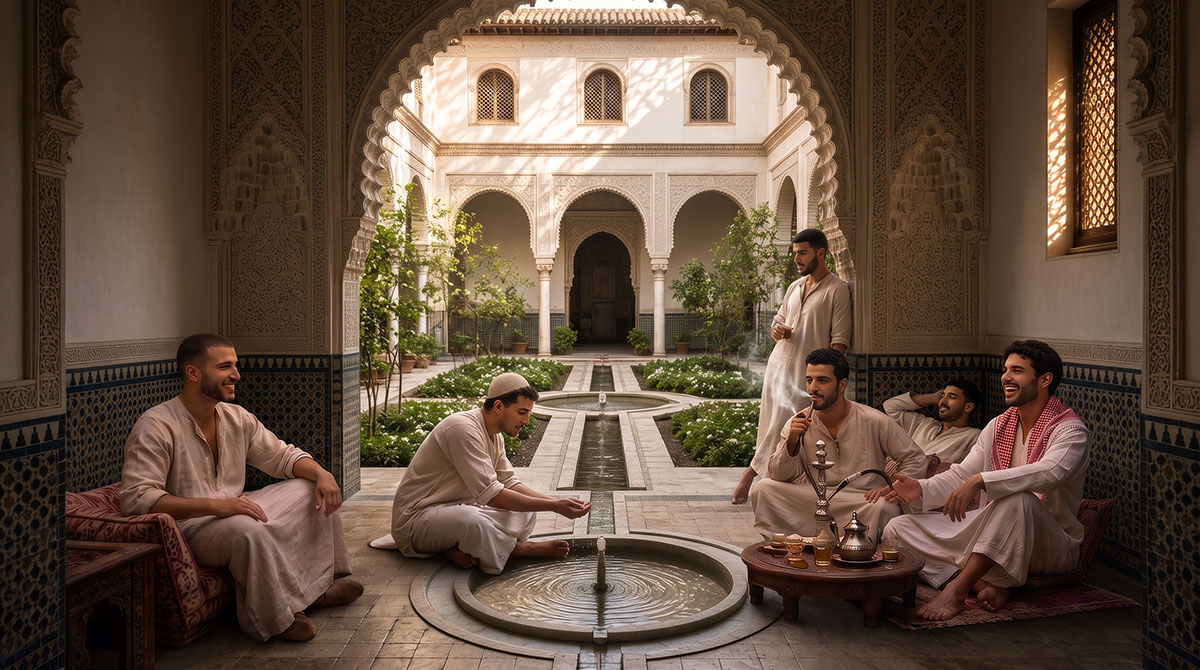
THE CONDITION OF FORMATION
Living, not just learning
The residency is the condition of formation. The craft, prayer, the body, the table and the evening conversation are not juxtaposed activities: they are a single rhythm, held together, day after day.
The man who emerges from it must be able to stand alone — a craft, a household, a word.
Age and commitment
Long-term residential formation is reserved for adults (18+). The formation workshops exist as an entry point, under conditions, for younger candidates or for those not yet ready to commit for the long term.
The priority remains the continuity of the crafts and the formation of men capable of standing firm — not the filling of places.
ENTRY POINT
Before the residency: the workshops
For those not yet ready to commit for the long term, Dar al-Hiraf welcomes temporary workshops: a few weeks alongside a master, in a single craft chosen in advance.
The workshop is a genuine entry point, open under conditions and accessible to candidates younger than the residency age. For some, it opens the way to an application; for others, it remains a complete experience in itself.
Discover the formation workshops →WHAT HOLDS THE HOUSE TOGETHER
The rules
The communal life of a number of men living under one roof, sharing workshops, meals and prayer, does not rest on goodwill alone: it needs a written framework, clear, given to each one.
Each resident receives, upon admission, the Riad's communal life regulations — the principles that make a dignified and orderly shared life possible: daily rhythm, mutual respect and brotherhood, room life, mentoring, guidance by the masters, dress code, use of devices, substances and health, visits and outings, and the procedure followed in case of a breach. The resident signs it before moving in.
This document remains, above all, an internal-use text — given and explained upon admission, not a communication tool. What is said of it here is only a glimpse; the full text is provided to any serious candidate who requests it.
Write to us to learn more →AL-ATHAR
At the end: the work received
The residency does not end with a departure but with a work. Each man leaves in the walls a piece of his own hand — a panel, a door, a basin, an inscription — chosen with his master, judged by him, and set in place before the community.
It is not carried away and not sold. It is entered in the register of the house, with the master's name and the year, and the man undertakes at the same time to pass on in his turn what he has learned.
The rule of the work left behind →