The inner spaces
From the threshold to the bedrooms — how the house closes itself, and to whom it opens.
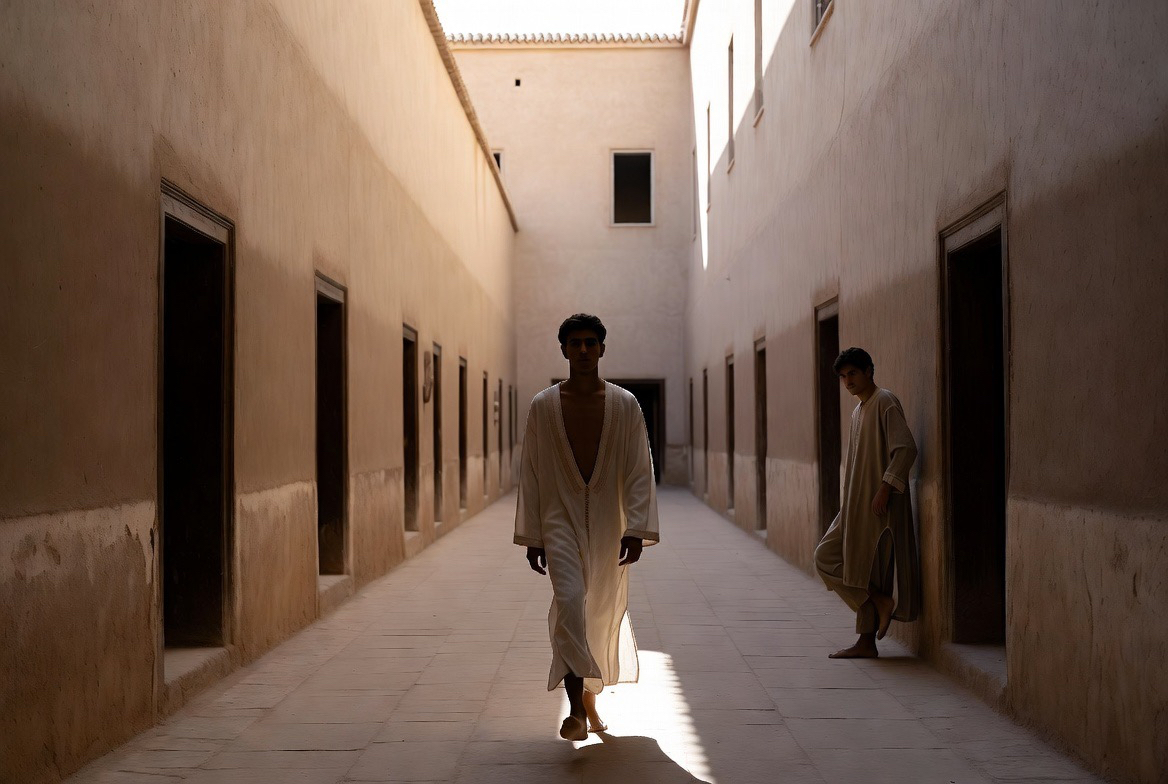
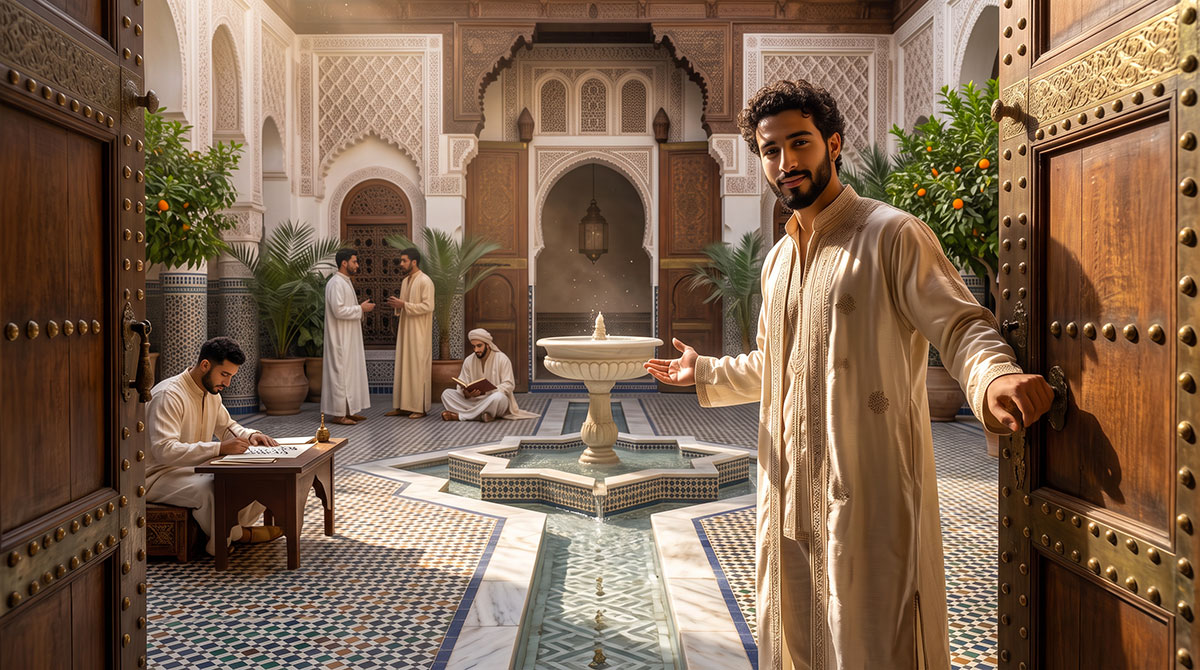
A house is understood by its door. The riad does not open onto the street: it turns away from it. Blind façades, a single door, and behind that door a bent vestibule — the driba — which prevents the eye from reaching the courtyard. This is not a precaution added afterwards: it is the first architectural decision, the one from which all the others follow.
What the bend protects is not a secret. It is the possibility, for those who live there, of genuinely being at home — of crossing the courtyard at dawn, of working, praying, keeping silent, without being seen by whoever passes in the derb.
A door that asks permission
The threshold — the ʿataba — is not, in the Islamic tradition, a simple boundary of property. The Qur'an makes it the object of a precise rule, and that rule contains, almost literally, the name of this house:
يَا أَيُّهَا الَّذِينَ آمَنُوا لَا تَدْخُلُوا بُيُوتًا غَيْرَ بُيُوتِكُمْ حَتَّىٰ تَسْتَأْنِسُوا وَتُسَلِّمُوا عَلَىٰ أَهْلِهَا
"O you who believe, do not enter houses other than your own until you have made yourselves known and greeted those who dwell in them."
— Qur'an, sūrat An-Nūr (XXIV), 27
The verb used, tastaʾnisū, comes from the root ʾ-n-s — the very root that gives al-uns, the cordial intimacy from which the house takes its name. To announce oneself before entering is therefore, in the language of the text, to seek to become familiar: to ask to be received rather than to slip inside. The exegetical tradition calls this gesture istiʾdhān, the asking of permission.
What is described below is nothing other than that verse translated into stone and plaster. A house that can be walked through without asking is not a hospitable house: it is a house that no longer belongs to anyone.
The three parlours
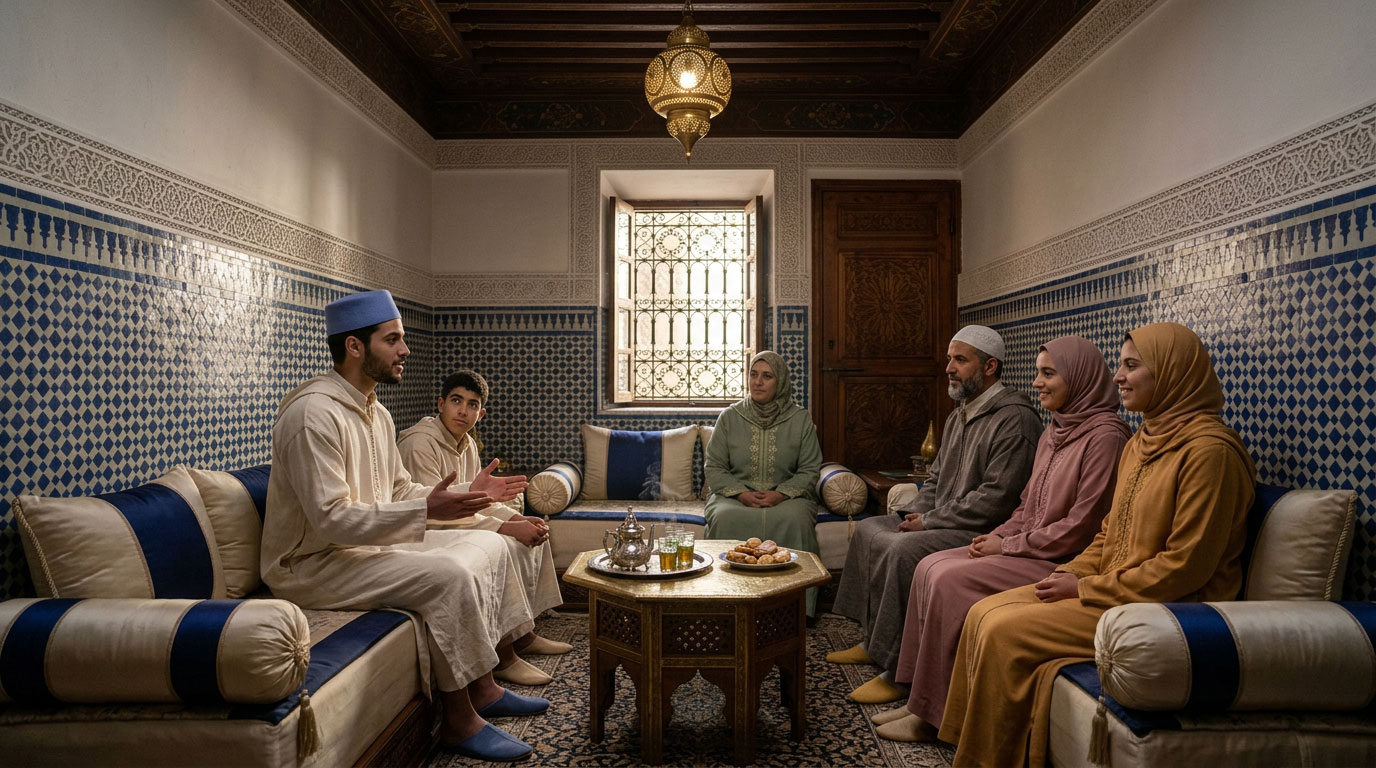
Three small rooms of some ten square metres open onto the driba, before the bend: the parlours. There — and only there — does the house receive what comes from outside. The mothers and sisters of the residents, families come to see where their son lives, suppliers, visitors passing through: all are received in the parlours, none goes beyond them.
Three rooms rather than one large hall, for a simple reason: three conversations can be held at once without anyone overhearing his neighbour, and yet there is still only one threshold to keep. This is the arrangement of monasteries and madrasas, and it has proved itself.
Each parlour has its own water point and its own facilities. The detail seems minor; it decides everything. A visit lasting two hours will eventually need something, and if that something lies inside, the rule gives way on the very first day — with the best justification in the world. No window looks onto the patio, and sound has been considered as carefully as sight: a Moroccan courtyard carries voices everywhere.
These three rooms receive the best the house knows how to make — carved plaster, zellige, a low seat, well-judged light. Not for display: because they are the only part of the house a mother will ever see, and the judgement she forms of the whole will be formed there, in that room and nowhere else.
Two doors that never open together
Between the derb and the house, the passage runs through an airlock. The visitor enters by the street door, the resident reaches the parlour by the door on the riad side, and the two are never open at the same moment. The control stays on the side of the house. Without this, a parlour would be merely a room near the entrance — which is to say, nothing.
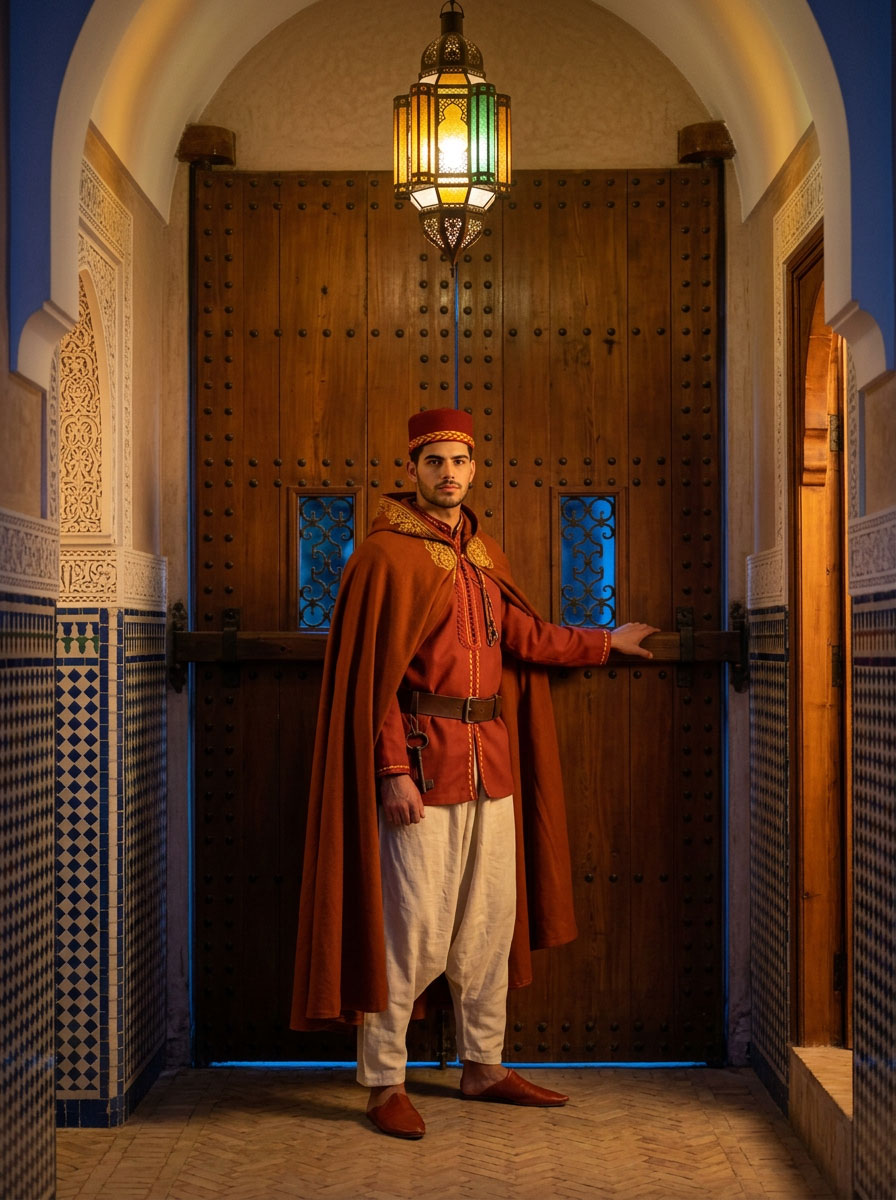
After ʿishāʾ, the door of the house is closed.
The bawwab
The threshold requires a man, and that man is a resident like the others — of the same age as those who live there, bound by the same rule. His charge is the door: it is through this work that he holds his place in the house, as another holds his at the loom or the chisel. It is not a makeshift post but a service in its own right, and that service is worth his lodging, his table and his formation.
The function also requires a body. To keep a door is at times to stand one's ground: an attempted break-in, a man turned away who insists, a restless night in the derb. The bawwāb is therefore chosen among the residents most advanced in the disciplines of the body — musāraʿa, taḥṭīb, zūrkhāne — not to intimidate whoever presents himself, but because a man sure of his strength has no need to raise his voice. The futuwwa lies precisely in that measure: to contain one's own force rather than deploy it.
His room is the first of the dormitory, the one that touches the threshold. He sleeps among the others and not at the door: he belongs to the house, and that is what distinguishes him from a guard.
The door is served from fajr to ʿishāʾ. Outside those hours it is not watched: it is shut. The door of a riad has always closed at nightfall, and here the house is only resuming a usage that precedes it by several centuries.
The dormitory and the rooms
Marrakech holds the model a few streets away. For four centuries the Ben Youssef madrasa housed the students of the city in more than a hundred tiny rooms, arranged around small courtyards on two floors. A few square metres each, one window, nothing more.
That smallness was not a poverty of means: it was a choice. A large room holds on to whoever occupies it and empties the common spaces. A narrow one returns him to the patio, the workshop, the table and the prayer — that is, to the others. The room serves for sleep, for study and for solitary prayer; the rest of life is held elsewhere, and must be.
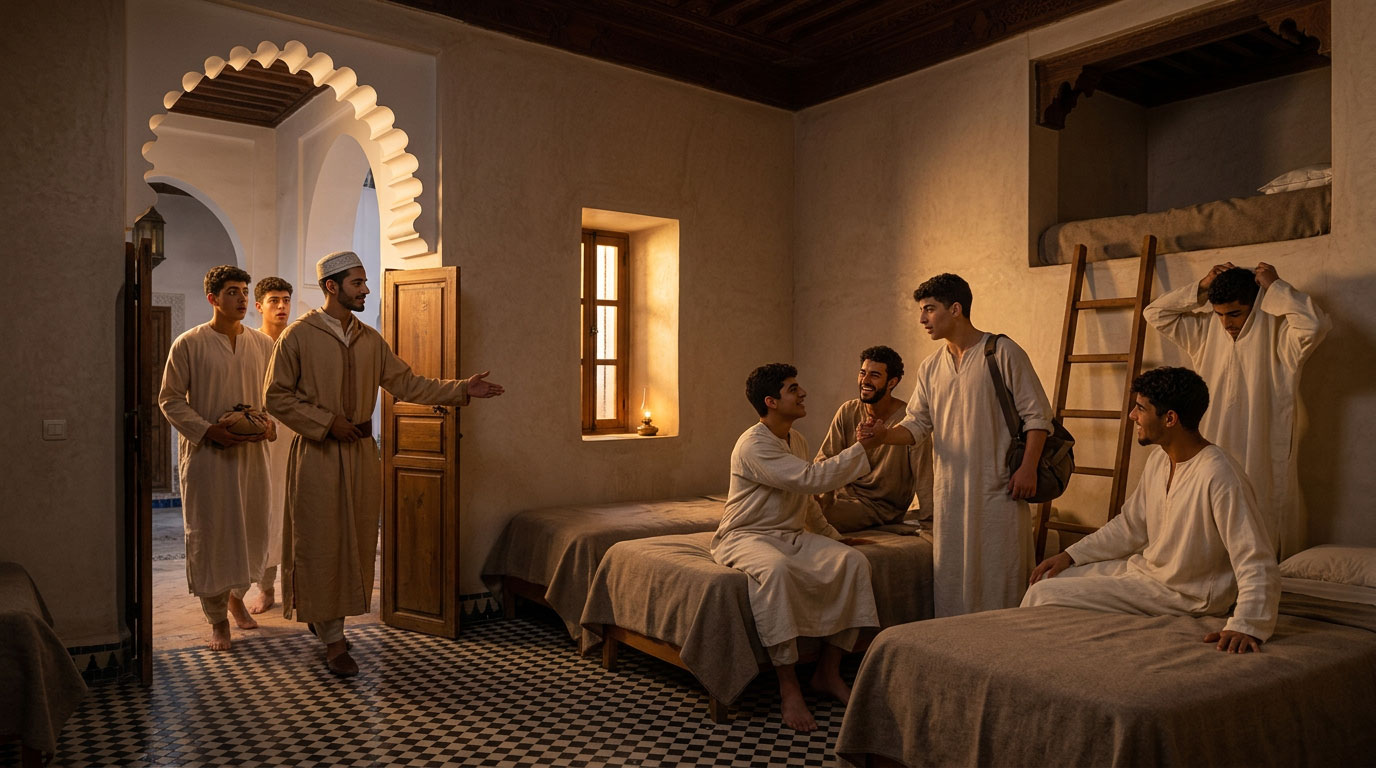
One does not arrive there at once. The first period is spent in the shared room: a few beds ranged in a single chamber, newcomers mixed with those only slightly ahead of them. Students on short courses lodge there too, for the length of their stay. Nothing is learned better than in that room — bearing others at close quarters, rising without waking anyone, keeping one's share of a space that belongs to no one.
The private room comes later, with the third grade of the ḥizām al-itqān, the one that marks the approach of mastery. It is not a privilege but one more charge: a door is entrusted only to a man whose use of it is already known. Dormitory therefore means the whole wing here — the shared room and the cells together, two moments of one path.
The upkeep of the room falls to the one who lives in it. It is the first of the common tasks, and the only one that is never delegated.
The terms on this page are gathered in the glossary of the house.