Patio
Inner courtyard, fountain, reflection of the sky — the silent heart of the house.
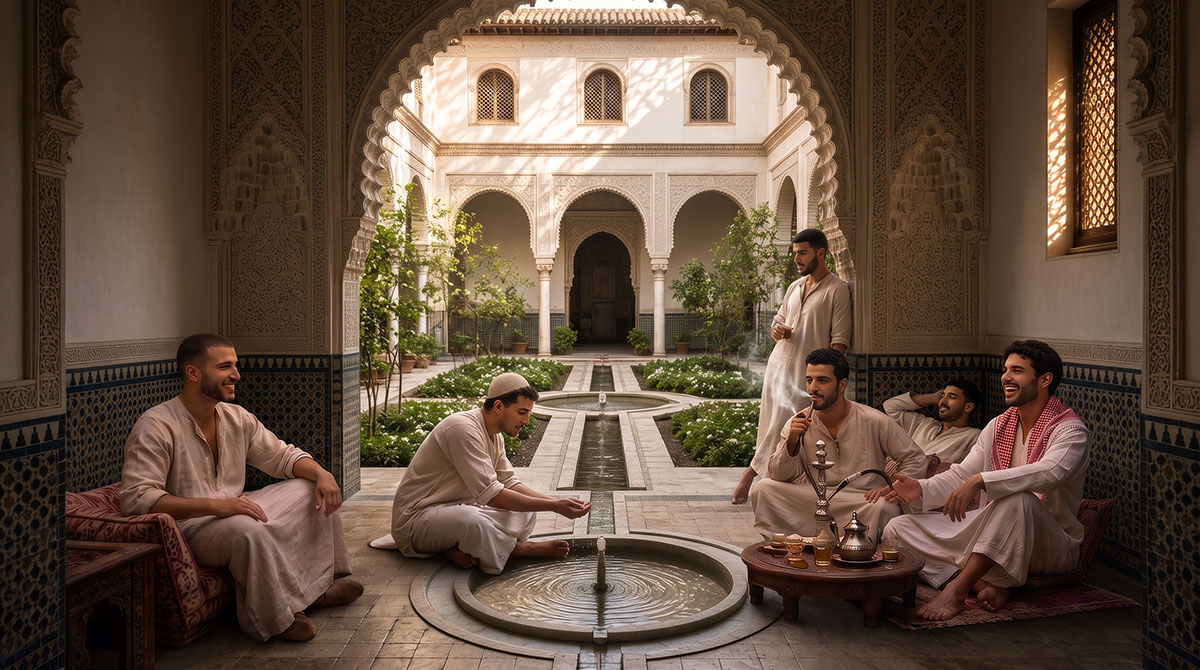
Inner courtyard closed to the outside, open to the sky — the patio is the silent centre around which the whole house is organised. Rooms, workshops and common spaces open onto it, never onto the street.
It is not a pleasure garden: it is a device — climatic, social, spiritual. It tempers the air, gathers without exposing, and its open sky recalls, to whoever lifts the eyes, a presence above the house.
An architecture older than Islam
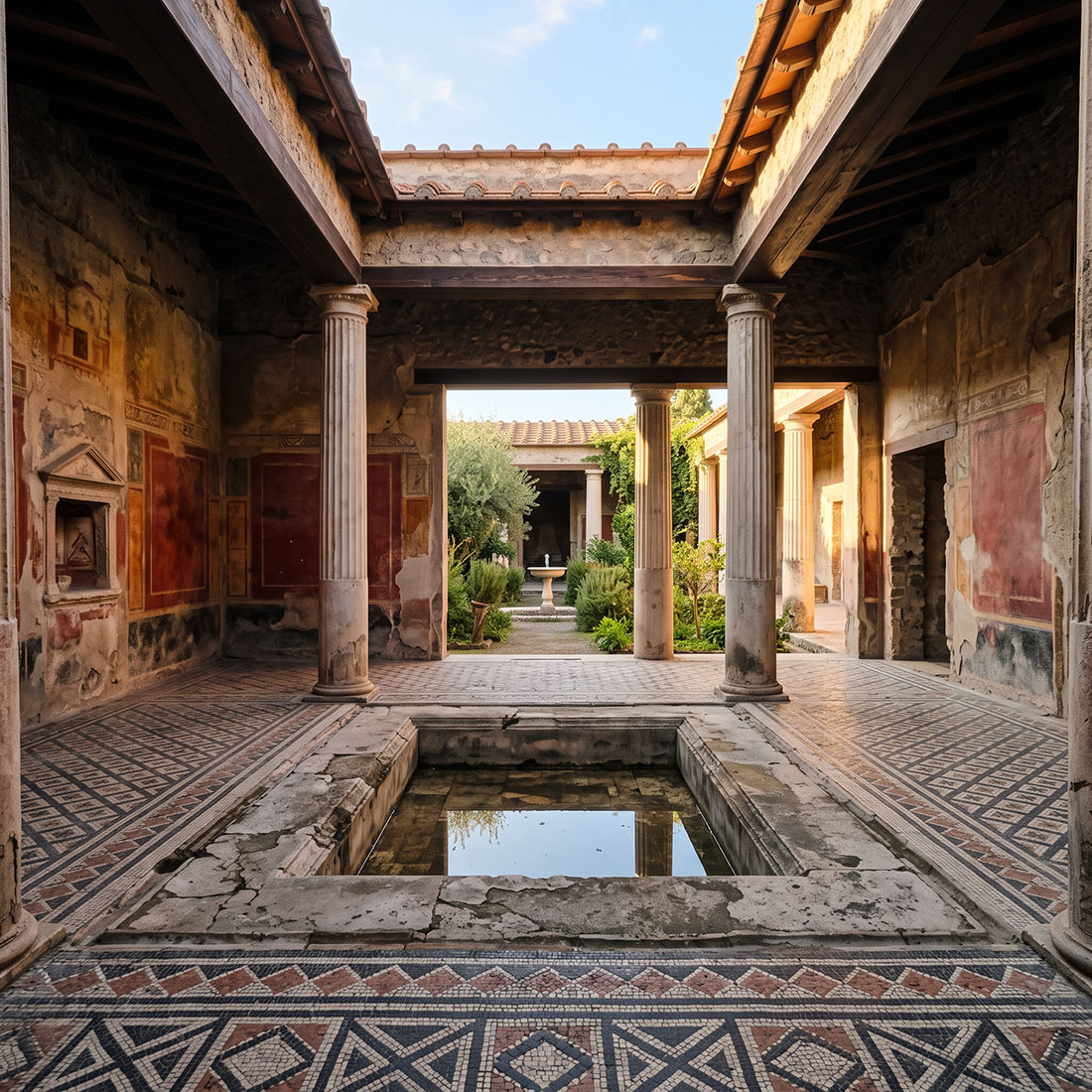
The house organised around a closed courtyard is not an Arab invention: it goes back to the ancient Near East, where it already constitutes, millennia before Islam, the domestic form of reference. Rome inherits it in its own way — the Roman domus, with its atrium, open-air courtyard that collects rainwater under the gaze of the sky: it is this same device that, by direct transmission, will become the Andalusian patio, then the Moroccan patio that the Riad perpetuates today. The Arabo-Andalusian world composes its own synthesis for the riad: the Mediterranean courtyard joined to the enclosed Islamic garden.
The same logic, as far as Sicily
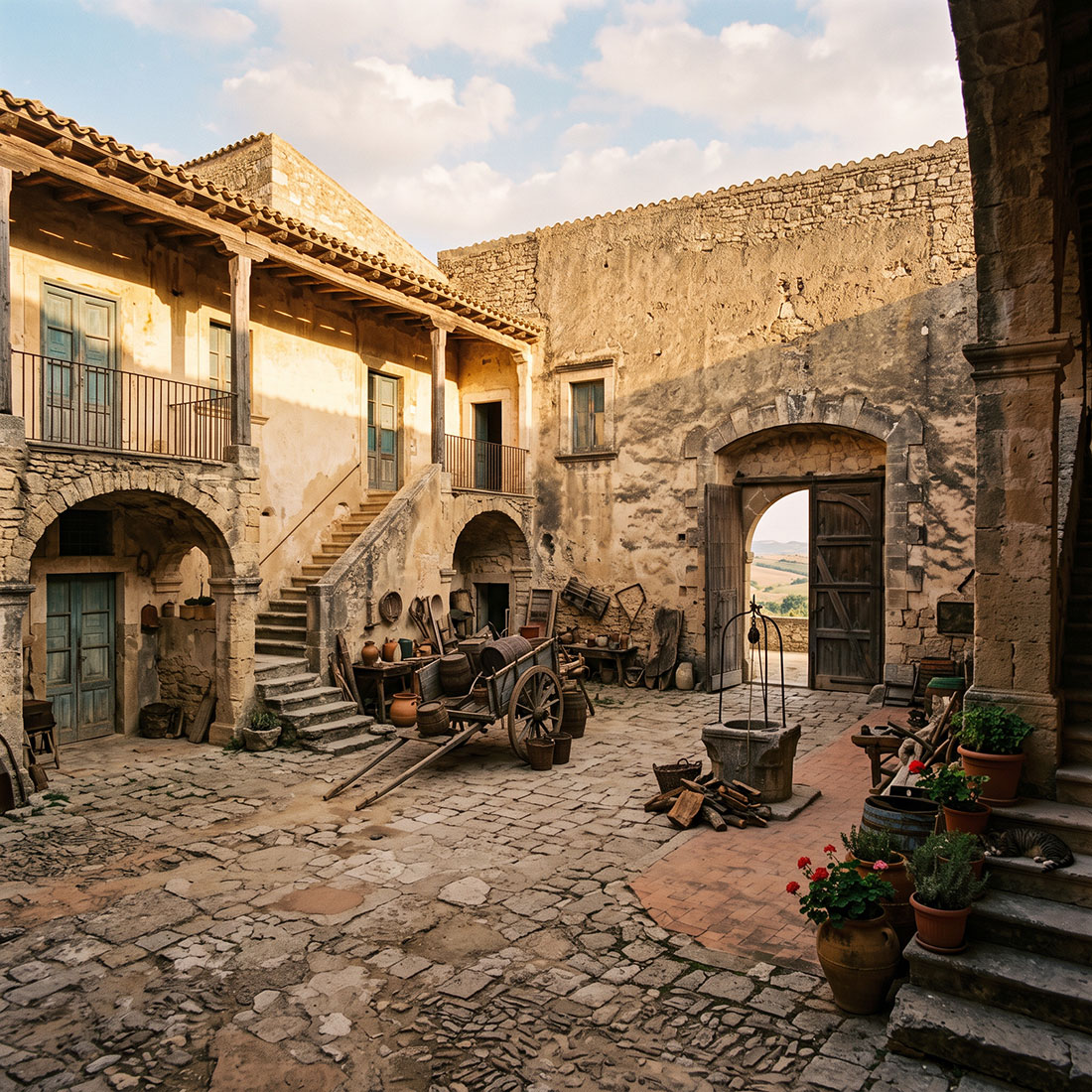
This same geometry — closed courtyard, blind façades toward the outside, life turned inward — reappears as far as Sicily in the baglio, the fortified masseria that still organises the rural landscape of the island today. Its name most likely comes from the Norman-French ballium (the fortified bailey of a castle, attested from 1194), even if a minority hypothesis sees in it a loan from the Arabic bahah (“courtyard”). What can be affirmed with certainty is that the architectural logic of the baglio — the same as that of the rustic Roman courtyard — joins, by distinct paths rather than by direct borrowing, that of the Andalusian and Maghrebi patio: a courtyard that one closes to the world the better to inhabit it.
A fountain, a verse engraved in stone
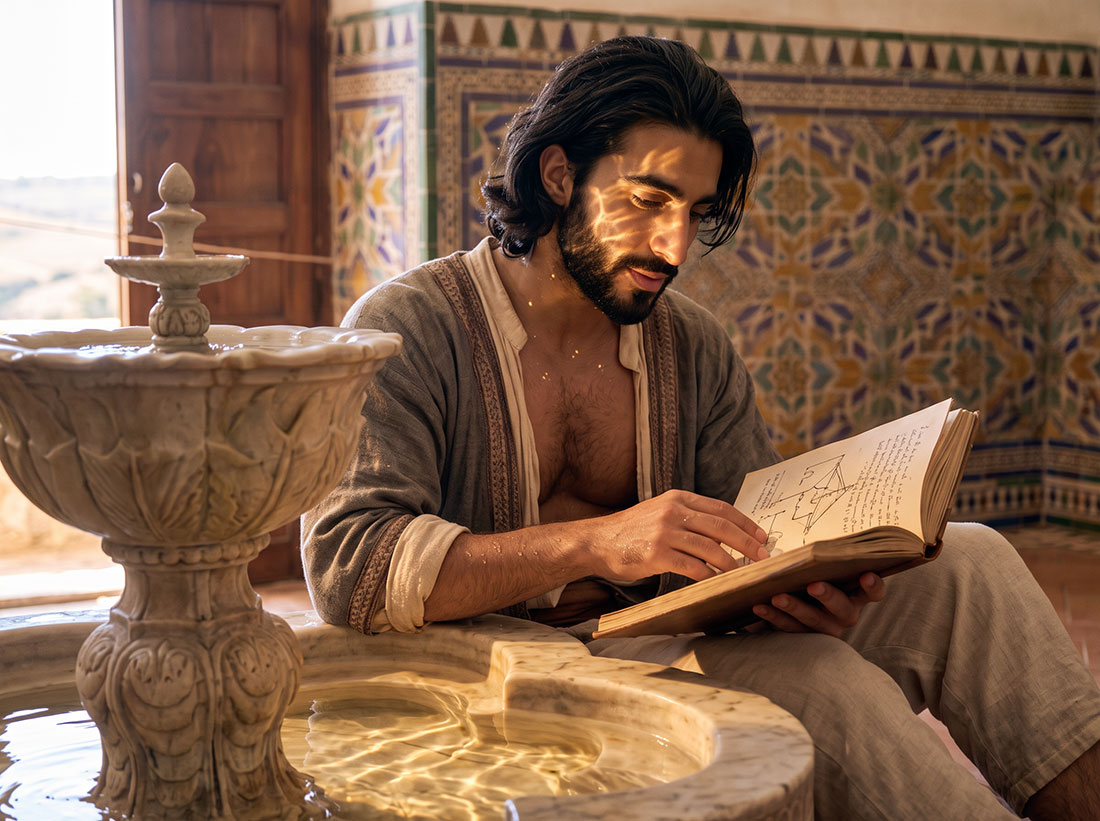
Nowhere has this encounter between water and stone been sung with more precision than at the Alhambra of Granada, where the poet-vizier Ibn Zamrak had his own verses engraved on the rim of the fountain of the Court of the Lions:
تَشَابَهَ جَارٍ لِلْعُيُونِ بِجَامِدٍ
فَلَمْ نَدْرِ أَيًّا مِنْهُمَا كَانَ جَارِيَا
« The moving and the still became confused to the eyes — we no longer knew which of the two was flowing. »
— Ibn Zamrak, poet-vizier of Granada (1333–1393)
What the verse describes — water so calm that it seems stone, stone so polished that it seems to flow — is the very experience of one who sits facing the patio fountain: an instant when the gaze no longer knows how to distinguish movement from rest.
The patio and its fountain are already sung in Water — Ibn Khafāja sees in it a river worth a kingdom.
What Ibn Zamrak’s verse describes at the scale of a fountain, the Riad lives at the scale of a life. The patio becomes the beating heart of formation: the young men who grow there do not learn only a craft or a gesture, but to recognise, in the order of the place, the order of the Creator Himself — force tempered by measure, passion disciplined by rhythm, the sky recognised even in the reflection of a basin. The patio is not an image of the cosmos: it is, at human height, its inhabited microcosm.
The terms on this page are gathered in the glossary of the house.